Trusted HVAC Experts SINCE 2014


Dehumidifiers
Humidity management is an essential part of protecting buildings, equipment and maintaining comfort. Our range of dehumidifiers are designed with easy and effective moisture control in mind.

Home Dehumidifiers

Industrial Dehumidifiers and Commercial Dehumidifiers

Desiccant Dehumidifiers

Compressor and Refrigerant Dehumidifiers

Wall Mounted Dehumidifiers

Low Grain Dehumidifiers

Garage Dehumidifiers and Shed Dehumidifiers

Dehumidifiers With Laundry Mode

Loft Dehumidifiers

Flood Dehumidifiers and Water Damage Dehumidifiers

Small Dehumidifiers

Large Dehumidifiers
Dehumidifiers For Professional Moisture Control
At National Heater Shops, we provide a wide range of dehumidifiers for a variety of different applications. These dehumidifiers are designed to provide reliable, high performance moisture control across commercial, industrial, domestic and specialist environments. They remove moisture from the air and collect it for disposal, leading to drier, more comfortable climates wherever they are installed.
Our available dehumidifiers are perfect for use in large-scale warehouses, factories, garages, lofts and homes.
Why Humidity Control Matters
The relative humidity of an area can have significant operational and financial consequences if it is too high. Typically, a relative humidity level of under 60% is ideal for many spaces, however certain equipment and dry storage conditions require less than 50% relative humidity to keep room contents safe.
Use our drying calculator to help calculate your dehumidification capacity.
A high relative humidity can lead to structural or equipment damage, due to an increase of moisture in the air. Relative humidity refers to the amount of water vapor present in the air, compared to what the maximum amount the air could hold at a specific temperature.
Excess moisture in the air can prove to be damaging for its surroundings, especially in areas where contents may be affected by moisture. Implementing the right dehumidification strategy helps to:
Protect inventory, equipment and assets.
Maintain building and structural integrity.
Improve indoor air quality.
Support production processes and ensure safety throughout these processes. Particularly for food production, electronics and pharmaceuticals.
Reduce long term costs.
Reduce risk of illness and airborne irritants.
For floods and leaks, check out our selection of water pumps to work alongside your dehumidifier.
Choosing Your Dehumidifier
When choosing a dehumidifier, multiple factors should be considered. There are many different types of dehumidifier to choose from, each with their own benefits and suitable applications.
The following should be considered when purchasing a dehumidifier:
Room size and ceiling height.
Desired humidity level.
Current humidity level and the current temperature conditions of the area.
Whether the unit will be temporarily or permanently used.
Drainage requirements.
The size of the unit and where it will be installed.
Energy efficiency.
For assistance in choosing the right dehumidifier for you, speak to our friendly sales team or use our contact form.
Different Types Of Dehumidifier
At National Heater Shops, we stock both compressor and desiccant dehumidifiers. These two types of dehumidifiers offer the same results but are appropriate for different conditions and applications.
Compressor Dehumidifiers
These humidity controllers work by utilising a series of refrigerated and heated coils to produce warm, dry air. Fans draw in the humid air from the atmosphere, where it is then passed over a refrigerated coil which allows for the condensate to drain into a collection tank or drainage system. The filtered air is then slightly warmed by a second coil or heating element, where it is then recirculated into the area. These are also known as refrigerant dehumidifiers and are generally more energy efficient and cost effective than their counterparts.
Desiccant Dehumidifiers
Desiccant dehumidifiers are typically called than compressor units, as they contain different internal elements. These dehumidifiers rely on a reticulated mesh of absorbent material called Zeolite which rotates on a wheel inside the unit. Ambient air is pulled in through a fan, where the rotor collects the moisture, and separate fans warm and recirculate the fresh, dry air. Absorption dehumidifiers are more efficient and effective for use in colder temperatures, and are commonly found in areas that average 10°C and below. As a result, they are usually used in boats, cold storage units, garages or other cold areas.
Robust, Trustworthy Dehumidifiers For Sale
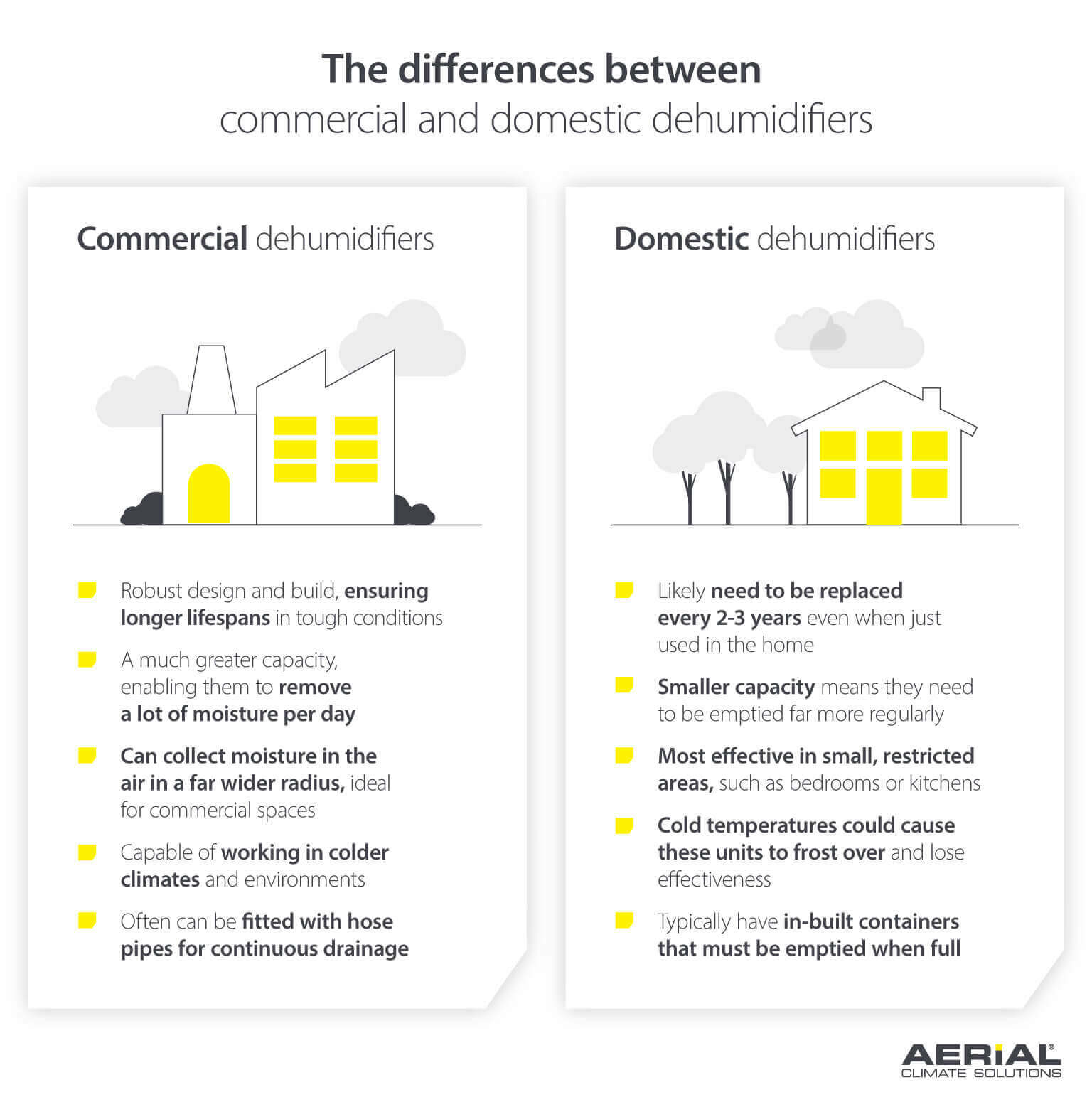
We offer a selection of domestic, commercial and industrial dehumidifiers from some of the UK’s leading brands. With options from Brolin, Delonghi, Dri-Eaz, Broughton and Sealey amongst others, both reliability and efficiency are guaranteed.
With moisture control options for various different locations, we sell options for larger industrial units such as the Dri-Eaz DrizAir 1200 Industrial Dehumidifier, smaller units for garages and other workspaces such as the EBAC CD30 Static Refrigerant Dehumidifier 230v, and units ideal for home use such as the Brolin BR10C Home Dehumidifier 230v.
Dehumidifier FAQs
Are desiccant or refrigerant dehumidifiers better?
Both desiccant and refrigerant dehumidifiers are used for different applications. Desiccant units are often used in lower temperatures, whilst refrigerants operate more effectively in warmer temperatures.
Can dehumidifiers run continuously?
Many commercial and industrial models are designed for continuous operation. Always check the product specifications for confirmation.
How do dehumidifiers drain?
Depending on application, dehumidifiers collect waste water in a removable internal bin which can be discarded, or continuously via a hose attached to a rear drain port.
Can a dehumidifier be used in winter?
A dehumidifier can be used in winter providing the relative humidity is high enough. Condensation, and excess moisture in the air can affect an area regardless of the time of year. A dehumidifier with laundry mode in particular is useful during winter, in order to help clothes dry.
Related Guides and Articles